5 Best Proposify Alternatives (2026)

Rikin Diwan··15 min read
Proposify is one of the original proposal tools. For agencies, consultancies, and sales teams who needed to send branded, designed proposals with e-signature at the end, Proposify built a real product around that job. The content library, the proposal templates, the analytics on opens and section views, the client-input forms: that whole motion was a category and Proposify helped define it.
The product is good. The pricing is harder to justify in 2026. Proposify's Basic plan is $19 per user per month on annual billing ($29 on monthly), and the Team plan that adds CRM integrations is $41 ($49 billed quarterly), with a per-user model that scales with every sales rep, not with the number of proposals you actually send. A five-person sales team on Team is $2,460 a year, and the Business plan is custom-quoted on top of that. Meanwhile, the underlying job (build a nice-looking document, send it, get it signed, collect payment) has been picked off by a wider field: AI-native contract tools, sales-CRM-integrated proposal tools, interactive-page proposal tools, and lightweight proposal tools that price for a single operator instead of a sales floor.
The deeper problem is that Proposify lives in the same world every document-generation tool of this generation lives in: once a proposal is signed, the data inside it (the payment terms, the renewal dates, the parties, the amounts) is locked back into a PDF. If your team wants to use any of it later, someone re-opens the document, re-reads it, and re-types it into a CRM or a spreadsheet. The signed copy ends a task instead of starting the next one.
Most teams looking for a Proposify alternative are not just shopping for a different proposal template editor. They want a tool that fits how their team actually sends documents in 2026: AI-driven setup, sensible pricing for the volume they actually send, and structured data extracted from every signed copy. These are the five strongest candidates in 2026.
Quick Comparison: Proposify Alternatives
| Tool | Best For | Lowest Paid Tier | Documents / mo |
|---|---|---|---|
| Proposify | Sales teams who need a designed proposal builder with a content library | $19/user/mo (Basic, annual) | Unlimited |
| Popform | AI-native contract management that works inside Claude and ChatGPT, one plan, every feature included | $11/user/mo (annual) | Unlimited |
| PandaDoc | Sales teams sending proposals, quotes, and order forms inside a CRM | $19/user/mo (Starter, annual) | ~9 (110/year cap on Starter) |
| Qwilr | Designed, interactive web-page proposals with embedded media | $35/user/mo (Starter, annual) | Unlimited |
| DocuSign | Pure e-signature with the broadest enterprise procurement footprint | $11/mo (Personal, annual) | 5 |
| Documenso | Open-source, self-hosted e-signature | $25/mo (hosted Individual) | Unlimited |
1. Popform: Best Overall Proposify Alternative
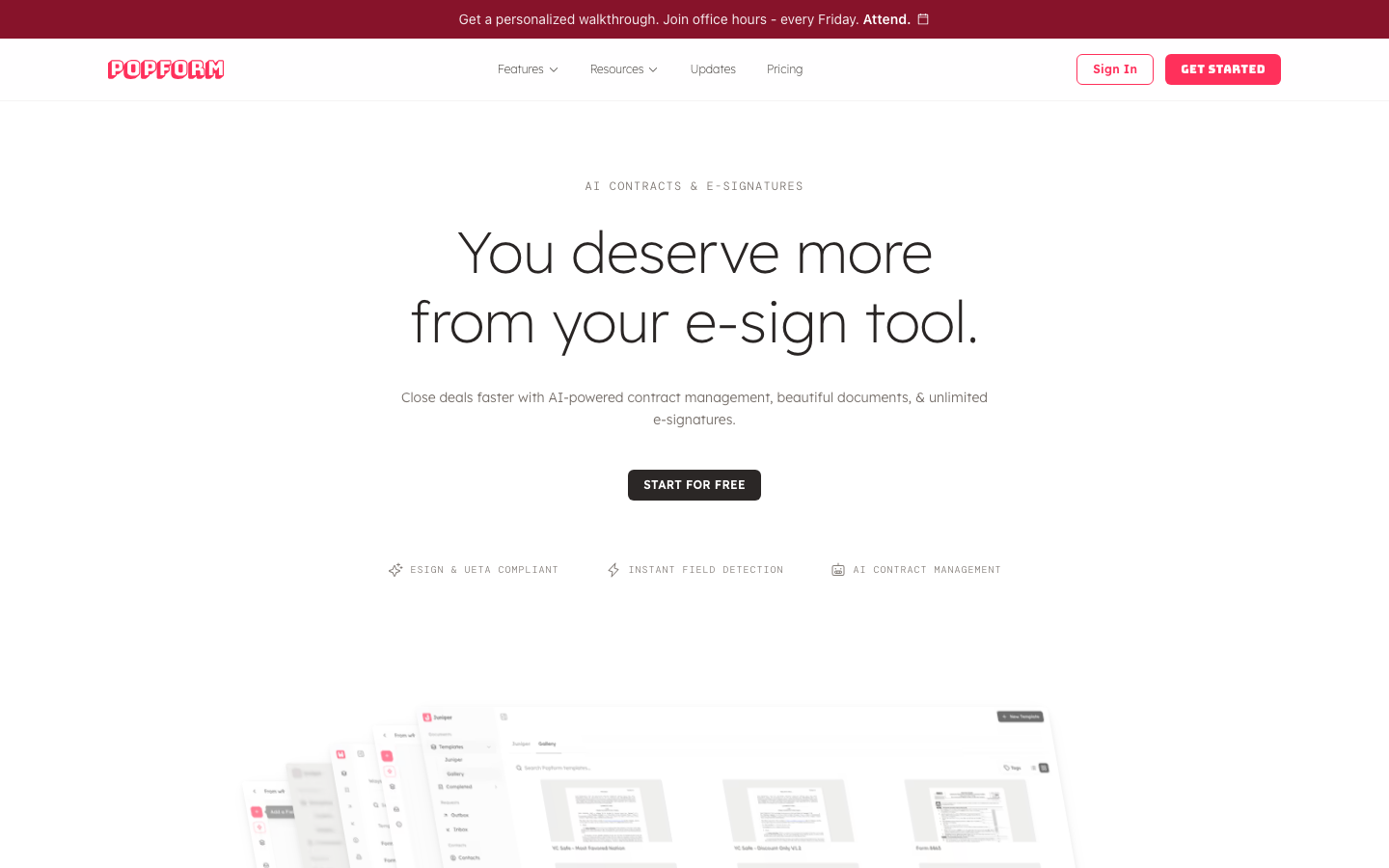 Popform: AI contracts and e-signatures
Popform is a modern contract and e-signature tool with AI handling the parts that used to take a human. Upload an existing PDF, such as a sales contract, MSA, order form, or signed proposal, and Popform's AI detects the signature fields, assigns the right recipients, and pulls the key business terms back out of the signed copy. No manual field placement, no caps on sending.
You do not have to start from a PDF, or even from inside Popform. Draft a new proposal or agreement from a prompt in Popform's editor, which supports both PDFs and markdown. Or connect Popform to Claude, ChatGPT, Grok, Perplexity, or Mistral through the Popform MCP and ask your assistant to create the document, send it for signature, check on its status, and pull key information out of everything you have signed.
What Popform does well:
- Connects to Claude, ChatGPT, Grok, Perplexity, and Mistral through the Popform MCP, so you can create documents, send for signature, check statuses, and ask questions of your contracts from the assistant you already use
- Goes from prompt to proposal in an editor that supports both PDFs and markdown
- AI detects signature, date, name, and amount fields automatically from any uploaded PDF
- AI assigns recipients based on what the document says, with no rules to configure
- AI extracts business terms (start and end dates, amounts, payment terms, renewal terms) from signed agreements
- Shareable links and activity tracking at every step toward signature
- Auto-organizes signed contracts by contact, company, and document category
- One plan: $11 per user per month billed annually, unlimited e-signatures, all AI features included
- ESIGN and UETA compliant
What Popform doesn't do: Popform is not a proposal-design tool. You can draft a proposal from a prompt and send it for signature, but there is no content library, no proposal template gallery, no embedded video, and no live pricing tables. If your sales motion depends on a beautifully designed proposal document at the front of the deal, you need a proposal-design tool (PandaDoc or Qwilr below), with Popform handling the contract that follows. Popform is also not a CLM. There is no redlining, no clause library, no negotiation room.
Pricing: One plan, $11 per user per month billed annually. No free tier (14-day free trial, no credit card required). Unlimited e-signatures and all AI features included.
Best for: Teams who used Proposify mostly as a contract-and-signature tool with proposal-shaped templates, and who realized they don't actually need the proposal builder. The signature, the field setup, and the data extraction are the parts that matter.
The tradeoff vs. Proposify: You gain a lower per-user price ($11 against $19 to $41), AI-driven setup, proposals and contracts you can draft from a prompt, and structured business data extracted from every signed copy. You give up Proposify's designed-proposal templates, content library, and proposal-stage analytics. If those are the reason you bought Proposify, see #2 or #3 below.
2. PandaDoc: Best for Sales Teams with CRM
 PandaDoc: proposals, e-signature, and contract management
PandaDoc is the most direct Proposify alternative for sales teams. It bundles document creation, e-signature, and CRM integrations into a single sales process, and it does the same proposal-to-close motion Proposify does, with a deeper CRM story.
What PandaDoc does well:
- Strong template library for proposals, quotes, and contracts
- Native integrations with HubSpot, Salesforce, and Pipedrive
- Document analytics that show when a prospect opens or hovers on pricing
- Payment collection alongside signature
- A free plan (5 documents/mo) and the same entry price as Proposify's Basic plan ($19/user/mo on Starter, annual)
What PandaDoc doesn't do: PandaDoc is sales-shaped. If your use case is HR forms, vendor onboarding, internal approvals, or ops paperwork, you are paying for proposal features you will never touch. The Starter plan caps you at 110 documents per year (around 9 a month), and meaningful capabilities (CRM integrations, content library, analytics) are gated to the Business plan at $49/user/mo.
Pricing: Free plan (5 documents/mo), Starter $19/user/mo (annual), Business $49/user/mo (annual), Enterprise custom.
Best for: Sales teams who want the same proposal-to-close motion as Proposify but with deeper CRM integrations and a lower entry-tier price.
The tradeoff vs. Proposify: You gain a deeper CRM integration story and a more flexible document model. You give up some of Proposify's polish on the designed-proposal side.
Read the full guide: 5 Best PandaDoc Alternatives (2026)
3. Qwilr: Best for Designed Interactive Proposals
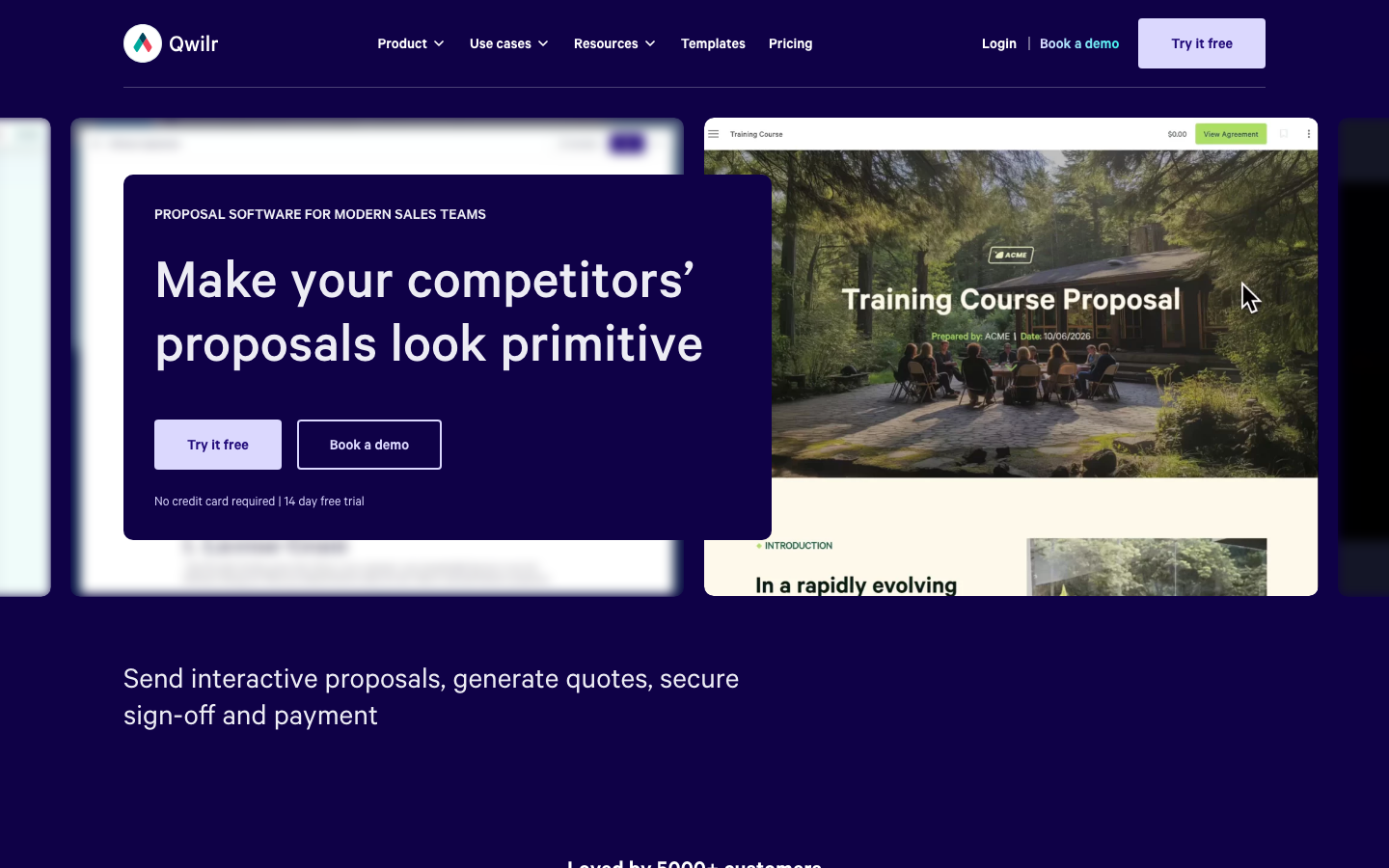 Qwilr: interactive proposals that make competitors' proposals look primitive
Qwilr replaces the static PDF proposal with an interactive web page. Embedded video, pricing tables that update live, and analytics on every section. If your reason for using Proposify was design, Qwilr is the upgrade path.
What Qwilr does well:
- Beautiful, on-brand proposals out of the box
- Interactive pricing with quantity adjustments
- ROI calculators and embedded media
- Section-level engagement analytics
- Better suited than Proposify to modern, web-native buyer experiences
What Qwilr doesn't do: Qwilr is a proposal tool first and a signature tool second. The signing experience is competent but not the focus, and it is overkill for routine documents like NDAs, vendor agreements, or HR forms. There is no real structured-data export; the proposal lives as a Qwilr page.
Pricing: Starter $35/user/mo (annual), Growth $275/mo (5 users, annual), Scale $750/mo (10 users, annual).
Best for: Agencies, consultancies, and sales teams whose proposals are part of the pitch and who want a more modern, web-native buyer experience than a static designed PDF.
The tradeoff vs. Proposify: You gain a far more compelling, interactive buyer-side experience. You give up Proposify's content library depth and the familiar designed-PDF format buyers in some industries still expect.
Read the full guide: 5 Best Qwilr Alternatives (2026)
4. DocuSign: Best for Pure E-Signature
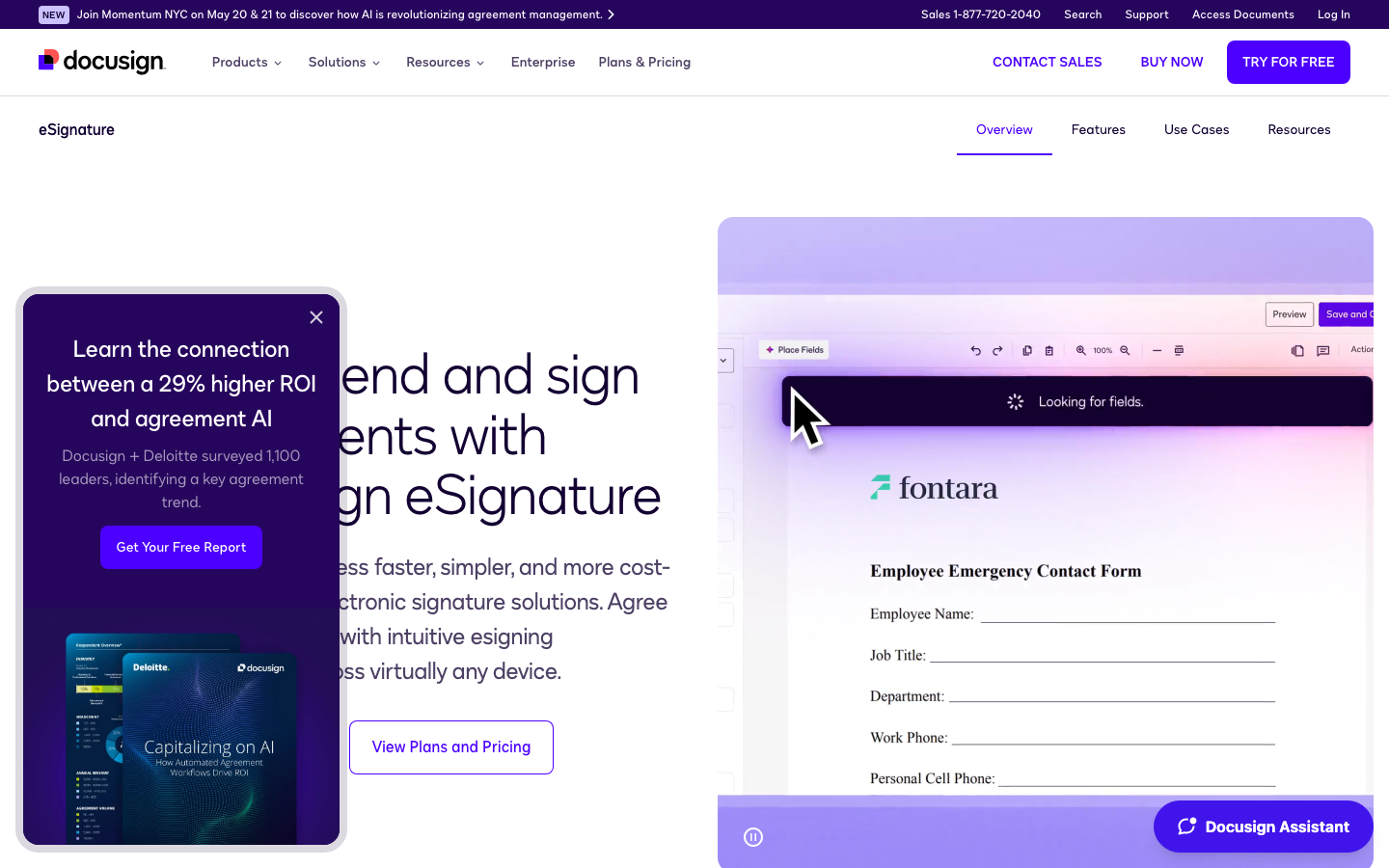 DocuSign: the e-signature incumbent
If you got to Proposify by way of "we just need to send and sign contracts" and the proposal features were a side effect, DocuSign is the cleaner answer for the signature side, especially if your buyers expect a recognizable brand on the envelope.
What DocuSign does well:
- The most recognizable e-sign brand for legal, finance, and procurement teams
- Deep integration footprint across Salesforce, Microsoft 365, Google Workspace, and major ERPs
- Mature audit trail and compliance posture (ESIGN, UETA, eIDAS, 21 CFR Part 11, HIPAA-eligible)
- Enterprise contract management add-ons available for teams that grow into them
What DocuSign doesn't do: DocuSign is not a proposal tool. There is no content library, no designed templates, and no proposal-stage analytics. The Personal plan also caps you at five envelopes per month, which most sales teams will burn through in a single Friday afternoon, so the real entry tier is Standard at $30/user/mo.
Pricing: Personal $11/mo (annual), Standard $30/user/mo (annual), Business Pro $45/user/mo (annual), Enterprise custom. AI data extraction costs extra: it requires a separate IAM plan, from $45/user/mo (annual).
Best for: Teams who were using Proposify mostly for the signature step and want a recognizable, enterprise-grade e-sign tool, with the proposal layer either dropped or moved into Google Docs / a slide deck.
The tradeoff vs. Proposify: You gain the strongest enterprise procurement story and the broadest integration footprint. You give up Proposify's proposal builder entirely.
Read the full guide: 5 Best DocuSign Alternatives (2026)
5. Documenso: Best Open-Source Alternative
 Documenso: enterprise-grade e-signatures, open source
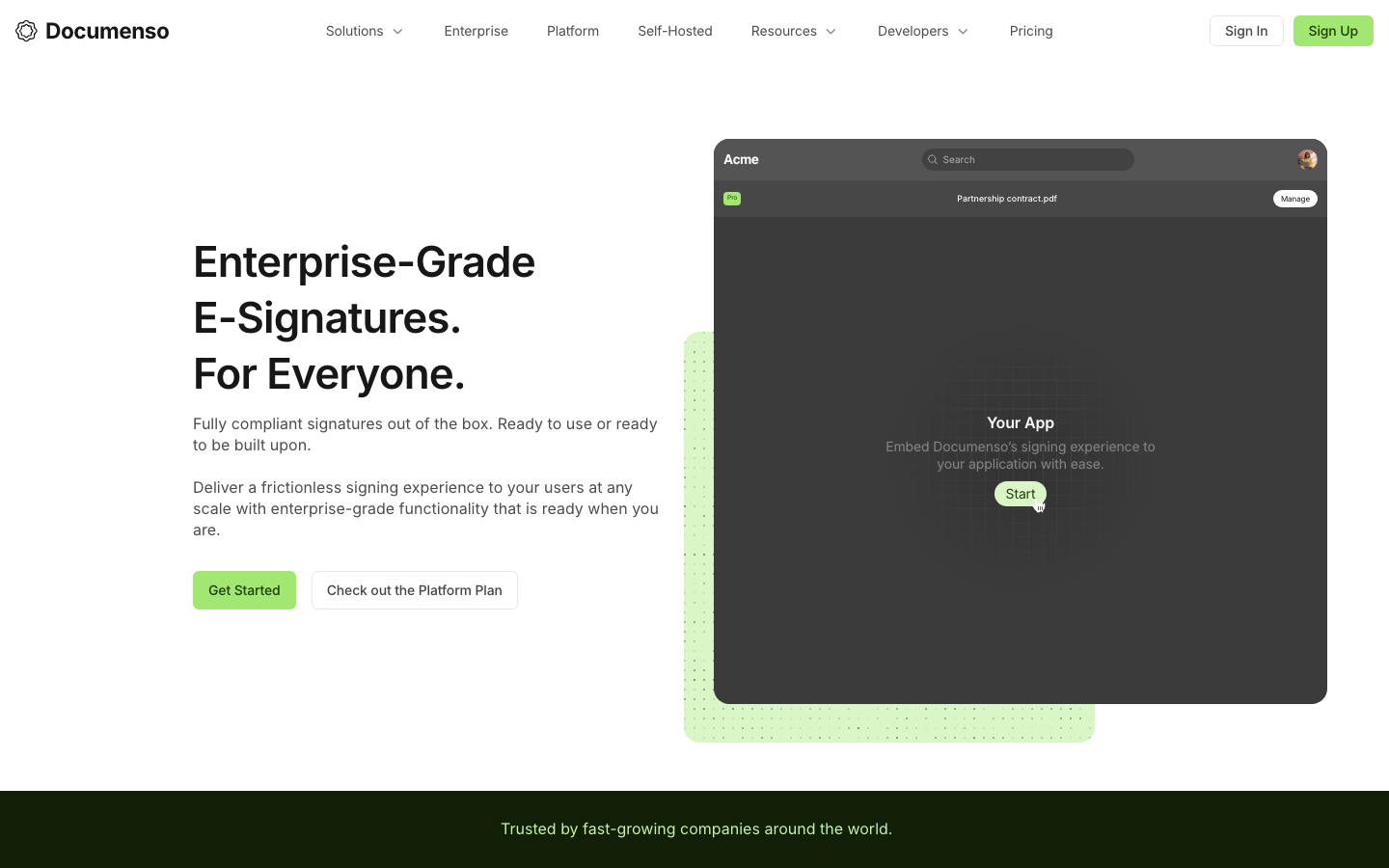
Documenso is the open-source answer to the signature side of Proposify's job. You can self-host it, audit the code, and avoid per-seat pricing entirely.
What Documenso does well:
- Fully open-source and self-hostable
- No per-envelope or per-seat fees on self-hosted plans
- Clean, modern signing UX
- Transparent roadmap and active community
What Documenso doesn't do: Documenso is focused on the signature primitive. There is no proposal builder, no content library, and no document analytics. Self-hosting also means you own uptime, compliance, and security posture, which is a real cost even if the software is free.
Pricing: Free self-hosted. Hosted plans start at $25/mo (Individual).
Best for: Engineering-led teams who want to own their stack and only need the signature primitive, with the proposal layer handled in whatever document tool they already use.
The tradeoff vs. Proposify: You gain control, transparency, and zero per-seat math. You give up the proposal builder and the polished managed-service experience entirely.
Read the full guide: 5 Best Documenso Alternatives (2026)
The Information Inside Your Contracts
The deeper question behind every Proposify alternative is what you want a signed proposal to be. If a signed proposal is just a finished PDF in a folder, Proposify is fine and most alternatives in this list will feel like overkill on either the design side or the signature side. If a signed proposal is a record of what your business agreed to (payment terms, renewal dates, parties, amounts, obligations), you want a tool that reads what's inside and gives that information back to your team.
That is why Popform exists. Documents contain the most important information about how your business operates and grows. A signed copy should not be the moment that information disappears into a PDF. It should be the moment your team gets it back.
How to Choose a Proposify Alternative
- If your team is sales-led and lives in a CRM. PandaDoc will fit the motion better, with a lower entry tier than Proposify.
- If the buyer experience matters more than the document. Qwilr's interactive web-page proposals are the modern answer.
- If you mostly need the signature, not the proposal builder. DocuSign (incumbent) or Popform (AI-native, $11/user/mo) are the right replacements.
- If you want AI to handle the setup tax and pull the key terms out of every signed agreement. Popform is built for this. Upload existing PDFs, get clean field detection and term extraction, $11/user/mo.
- If you want to run contracts from Claude or ChatGPT. Connect the Popform MCP, then draft, send, and look up agreements by asking. It is included in the $11/user/mo plan.
- If you want to self-host. Documenso is the only serious open-source answer here.
Bottom Line
Proposify is a good answer to a specific question: how do we send a designed, branded sales proposal and get it signed without stitching three tools together? That question is still valid for agencies and consultancies where the document itself is part of the pitch. For everyone else, the per-seat math no longer matches the underlying job.
If you are leaving Proposify because the proposal builder is the wrong center of gravity for your team, look at PandaDoc for sales-CRM integration, Qwilr for interactive buyer experiences, or Popform for AI-driven drafting and signing at $11 per user. If you are leaving because the signed document is a dead-end PDF and your team keeps re-typing the data inside it, start with Popform. Bring your existing Proposify PDFs or draft from a prompt, let the AI handle the setup, and get the information back that you used to lose the moment a proposal was signed.
More Comparison Guides
Looking at other tools in the category? Popform has a full alternatives guide for each:
- 5 Best DocuSign Alternatives (2026)
- 5 Best Adobe Sign Alternatives (2026)
- 5 Best HelloSign Alternatives (2026)
- 5 Best Dropbox Sign Alternatives (2026)
- 5 Best SignNow Alternatives (2026)
- 5 Best PandaDoc Alternatives (2026)
- 5 Best Qwilr Alternatives (2026)
- 5 Best Documenso Alternatives (2026)
- 5 Best Agree.com Alternatives (2026)
FAQs
What is the cheapest alternative to Proposify?
Popform is the cheapest managed alternative for the drafting and signing part of Proposify's job, at $11/user/mo (billed annually) with unlimited signatures and AI included. If you specifically need a designed-proposal builder, PandaDoc Starter at $19/user/mo (annual) is the cheapest published proposal tool that approximates Proposify's feature set. Documenso is cheaper still for pure signature if you self-host it.
Are Proposify alternatives legally valid for contracts?
Yes. Electronic signatures collected through any reputable e-sign or proposal tool are legally valid under the ESIGN Act and UETA in the United States, and under eIDAS in the EU. Popform, PandaDoc, Qwilr, DocuSign, and Documenso all produce compliant signatures with proper audit trails. The brand on the envelope does not change the legal weight of the signature.
Can I import my existing Proposify templates into another tool?
A direct template-to-template migration from Proposify is rarely supported. PandaDoc and Qwilr each have their own template models. Popform's AI side-steps the template problem entirely by detecting fields automatically from any PDF, so you do not have to rebuild templates at all. Export your Proposify content as a PDF and upload it directly.
Is Proposify still worth it in 2026?
Proposify is still worth it for one specific case: an agency or consultancy where the proposal document itself is part of the pitch, the team needs a deep content library, and the per-seat price is justified by the design quality of every proposal sent. For teams that mostly want contract execution with a designed wrapper, the alternatives in this list are a better fit.
Does Proposify have a free plan?
Proposify offers a 14-day free trial, but there is no permanent free tier. The lowest paid plan is Basic at $19/user/mo (annual); Team is $41/user/mo (annual).
Which Proposify alternative works with ChatGPT or Claude?
Popform. The Popform MCP connects your account to Claude, ChatGPT, Grok, Perplexity, and Mistral. From there you can ask your assistant to draft a document, send it for signature, check whether it has been signed, or answer questions such as what a contract is worth and when it renews. It is included in the $11/user/mo plan.
Which Proposify alternative is best for small businesses?
It depends on where the value was. If you used Proposify mostly for the proposal builder, PandaDoc Starter at $19/user/mo matches Proposify's Basic plan on price and has a free plan below it. If you used Proposify mostly to send and sign contracts, Popform at $11/user/mo costs less per user and adds AI-driven field detection and term extraction on top.
Related articles
6 Best SignOwl Alternatives (2026)
SignOwl is a clean, mobile-first e-signature tool, but its free plan is tiny and its AI stops at field placement. Here are the 6 best SignOwl alternatives in 2026.
16 min read
5 Best Adobe Sign Alternatives (2026)
Adobe Acrobat Sign is great if you live in Acrobat, but the per-seat price and transaction caps push teams elsewhere. Here are the 5 best Adobe Sign alternatives in 2026.
14 min read
5 Best Dropbox Sign Alternatives (2026)
Dropbox Sign (formerly HelloSign) is clean and focused, but the per-seat pricing climbs fast for small teams. Here are the 5 best Dropbox Sign alternatives in 2026.
14 min read